
As Beekeepers, We Choose Our Complications
Mention the Demaree swarm management method to a beekeeper and you are likely to get the deer-in-the-headlights look. It can seem daunting and unapproachable. Yet, swarm season is also equally daunting. The fact is, that many beekeepers (myself included), do not want to continue to grow their apiary. Whether you want to keep your yard at two colonies or 100 colonies, sometimes you get to a point where things are good and you would rather not keep splitting hives to control swarming, buying more equipment and having to find new places to put these colonies. Charles Demaree thought the same thing back in the 1800s. His goal was to maximize honey production while maintaining the full strength of the colony.
I was asked to write an article on the Demaree because I have a bit of experience with it. Let me begin by saying that I have only used the Demaree for two seasons (2024 and 2025). Both seasons were drastically different and taught me a lot. I am NOT an expert on this modification; I can only explain what I have observed and experienced. I have been keeping bees for only about seven years. I feel like I kind of know how to keep them alive at this point. The more I learn, the more I realize how much I still need to learn. I started researching the Demaree in 2023 to keep my apiary from growing too much and to maximize honey production. I was intrigued and wanted to know more. I run an average of 30 colonies at any one time (minus spring nuc production) and that is plenty. I did not want to keep increasing the number of colonies I have.
There are a plethora of articles and beekeepers that speak on the Demaree, so more information is out there. It is confusing and there are so many variables to consider. So, without further ado, let’s see if we can peel back the layers a bit to ease some of the confusion.
A Brief History of the Demaree Method
George Demaree first published an article on this swarm management method in the American Bee Journal in 1892. He was a pioneer in swarm control methods. He was born in Henry County, Ky. in 1832 and died in Shelby County, Ky. in 1915 at the age of 82 (https://sassafrasbeefarm.wordpress.com/2022/01/27/happy-birthday-george-whitfield-demaree/). Mr. Demaree realized the importance of keeping the bee population at its maximum to allow for a generous honey harvest.
We all know what bees like to do when they are strong, healthy and feeling good. It is their instinct to reproduce and they do this by swarming. Some bees are more swarmy than others. Some will launch out first chance they get, while others are a bit more reserved. A beekeeper can easily lose 50 percent of their bees to swarming, quite possibly more. There goes your honey production workforce right out the front door! However, splitting a hive to prevent swarming also reduces the workforce. What is a beekeeper to do? The idea behind the Demaree is to “trick” the bees into thinking they have swarmed, thus keeping the population intact. By separating brood and nurse bees from the queen and foragers, a beekeeper can get his colony back on track to focus on honey production and not lose any of the workforce.
Timing is Everything
But HOW do we go about this? WHEN do we go about this? How I wish I had the magic crystal ball to peek into to see what Mother Nature’s spring plans are and how the spring flow is shaping up. Wouldn’t that make things simpler?
Before I go any further, I would like to point out that I have seen articles and YouTubers call the Demaree a “swarm prevention method.” I do not like that term personally because if it is not done when the window of opportunity presents itself, you are still going to find your bees in the trees. And as we all know, if bees are wanting to swarm, it is hard to persuade them otherwise. Timing is everything. Staying on top of each colony is everything. It is labor intensive, time consuming and, as I found out last year, frustrating. Frustrating because I could not rely on dates or the time frames I had used previously. In his book, “Fifty Years Among the Bees,” Dr. C.C. Miller talks specifically about the variableness of the seasons (p. 131). He discusses the importance of having a stockpile of equipment ready to go. Dr. Miller also makes a note of dates of his observations of blooming plants and birds returning (p. 124-126). He gives examples of seasons arriving early, thus emphasizing changing variables. Even back in the 1800s and early 1900s, dates were not a reliable method for hive manipulations.
I really appreciate the little phrase my good friend and mentor, Jake “Beeman” Barker, uses when facing bee adventures. Jake is a dual master beekeeper, Cornell and EAS certified. As he says, sometimes you have to “ride the tiger” to accomplish the goal you have set forth. Yep, that applies here!
Mother Nature Always Keeps Us Guessing in Kentucky
The first item to take into consideration is the area in which we live. According to Jake, peak flow dates in Oldham County are not a reliable variable. “A lot is dependent early on in the season on the ifs-and-when of locust and tulip poplar and if they hit or if they are duds,” he said. He also notes that a lot of the swarm control advice out there is from beekeepers in regions that have swarm and queen rearing seasons starting a month before the main flow, which is a luxury this area just doesn’t have. Jake throws every trick out there to keep bees from swarming until approximately May 1 when he is able to rearrange them accordingly. He relies on home-grown double-queen set ups to maximize the workforce and thwart swarming. He also is quick to point out that the Demaree needs repeating for long-term success in this area.
Two Very Different Seasons: 2024 vs. 2025
My area experienced a wonderful locust flow in April 2024. We had had a mild winter and did not have a late freeze in April. The stars aligned! I Demaree’d my hives the first week of April because the nighttime temperatures allowed it, generally 50 to 55 degrees. It greatly reduced swarming events in my yards. Nectar was coming in and this turned them into honey-making machines.
However, spring 2025 was completely different for me. We had experienced drought conditions the previous fall. The trees were stressed due to lack of moisture and went dormant without taking in an ample moisture supply. In early April, Oldham County had a major rain event during the time the spring trees were blooming. We ended up with nine inches of rain. I did not realize it at the time, but those two weather events greatly impacted our honey crop. The signs were all around me, but I did not know enough to realize that I really needed to pay attention. Last year taught me a lot.
I mention this because this demonstrates how weather plays a key role in determining when to manipulate hive boxes. My timing on the Demaree for 2025 was based on 2024, which worked perfectly. Why wouldn’t it work for 2025? Well, the spring nectar was not there. My bees could not adequately build up because of the absence of nectar. In hindsight, I should have been feeding them. However, I very rarely feed in the spring because there is “usually” always nectar coming in. They were all over my shop and garage scrounging and rummaging through every nook and cranny looking for food. At the time, I thought that was peculiar, but I didn’t put the puzzle pieces together in time to avert disaster. I Demaree’d my production hives at the wrong time. There was little nectar coming in. The nectar flow arrived with the clover two to three weeks later. It wasn’t comparable to a spring tree flow, but it was noticeably better. Because I had not paid attention to the warning signals blaring at me, my hives got bound and they swarmed not even three weeks afterward. Every single one of them. The 2025 season was a humbling experience for me.
So, timing is everything. Paying attention to the clues is equally as important. I learned with my first attempts that this is not a once-and-done method. There are so many variables.
From my understanding, it is very important to conduct the first round of Demaree-ing BEFORE the bees think about swarming. If you see them hanging queen cells, you are too late and need to split them into submission if you want to keep your bees. I also need to note that many beekeepers let nature take its course and let their bees swarm. They also still have a very good honey crop. They build nucs from the swarm cells; queens produced from swarm cells are excellent quality. Each beekeeper has their own way of doing things, which is awesome because there are so many ways to keep bees. You have to find what works for you.
I am Jake trained and he taught me to manage swarming because he also taught me how to set up for spring nuc production. Each spring, I identify my production hives and nuc-producing hives. I graft and raise queens for the spring nucs I sell, so I just do things differently. But, I have been able to come up with my own system for what works for me. I like the Demaree because, if done properly, it allows me to maintain the population of my production hives to better the chances of a good honey crop. I will be tinkering with a few other modifications this spring because, again, I am still figuring out what works for my yard.
Knowing When to Act – and When Not To
But, I digress. As mentioned above, the Demaree has to be done early on. This is where that crystal ball would come in handy. Jake has said that April 1 is a good date to aim for, but the weather here can really throw a wrench into everything and wreak havoc. Instead of relying on dates, I am learning to observe the signs. I like to see bees bringing in pollen and nectar, happily working, building brood and enjoying spring. I do not want to see them in my shop and garage in the search for food. I also do not want to see them following me around in my Polaris and hovering because they know I am a free food truck.
Buying Time: Equalizing, Reversing, and Keeping Bees Busy
I use the equalizing method to buy time until I feel I can move forward with the Demaree. If you are unfamiliar with equalizing, it is simply removing a frame or two of brood from the strong colonies and giving to the weaker colonies to balance out everyone. Some colonies I run as single deeps in the winter; some colonies are doubles. I keep an eye on populations, brood, patterns and comb production to determine when it is “go” time. I also pay attention to the trees budding and dandelion blooms. I do absolutely everything I can to keep the bees at bay as long as it is feasible. If they need another box, I’ll give them another box. If they must be reversed, I will reverse them. It is important to mention that hives should not be reversed if the cluster is in both boxes. If you reverse when the brood is in both boxes, this risks chilling the brood that gets separated. Breaking the cluster in cold weather will cause a lot of damage. If the entire cluster is in the upper box, and the bottom box is empty, THEN you can proceed with the hive reversal. Please take note that those colonies might need to be reversed again.
If we have a mild winter, preparations begin sooner. I believe it was in 2024 that Louisville started reporting swarms in March. The winter was incredibly mild. The winter of 2025 was much colder with more snow. We also had a cold, wet spring. Brood production was slower to kick into gear.
Honey bees are literally like toddlers in the early spring. They have to have something to do. If you can keep your bees busy until around the end of March through April, this will help divert their attention to more important matters. In addition to adding boxes to singles and reversing doubles, I like to throw a foundationless frame on the edge of the broodnest to keep them busy. I give them a foundationless frame at the first sign of drone comb in the feeder shim. They will use their fondant and food resources to build the comb. They will be thrilled with this gift you have bestowed upon them. And, it buys you time and keeps them busy. Again, this is what works for me.
The Ohio Valley has definitely had freezes well into mid- to late April, as well as early May around Derby time. The long-range weather forecast apps are seldom reliable, and that is one reason why dates are also unreliable as predictors of when to do modifications.
Let’s move ahead to mid to late April. The beekeeper has stayed on top of things by equalizing, adding boxes, reversing boxes if appropriate, throwing in a foundationless frame, reversing again if needed…anything to buy time until the nighttime lows start stabilizing to 50 to 55 degrees. I hesitate to conduct a Demaree with lows still in the 40s due to the risk of chilling the brood. Jake aims for May 1 as a target date for splits and major hive manipulations. Usually the weather is more on par for grafting, queen rearing, Demarees and other management strategies. Let me reiterate that one cannot rely on a particular date. Pay attention to the weather and the clues nature is providing.
I want to reiterate that a Demaree is time consuming, labor intensive and not for the faint of heart. If you are still with me and wish to proceed, please pay attention to the following steps and mark the day on your calendar that you began the Demaree.
Step-by-Step: How to Perform the Demaree
- Identify your strong hives you wish to use as production hives (in other words, the bees that you really do not want to lose to a swarm).
- Have a good space to work with; I often set boxes on top of the outer covers or little aluminum benches that I keep at the hives.
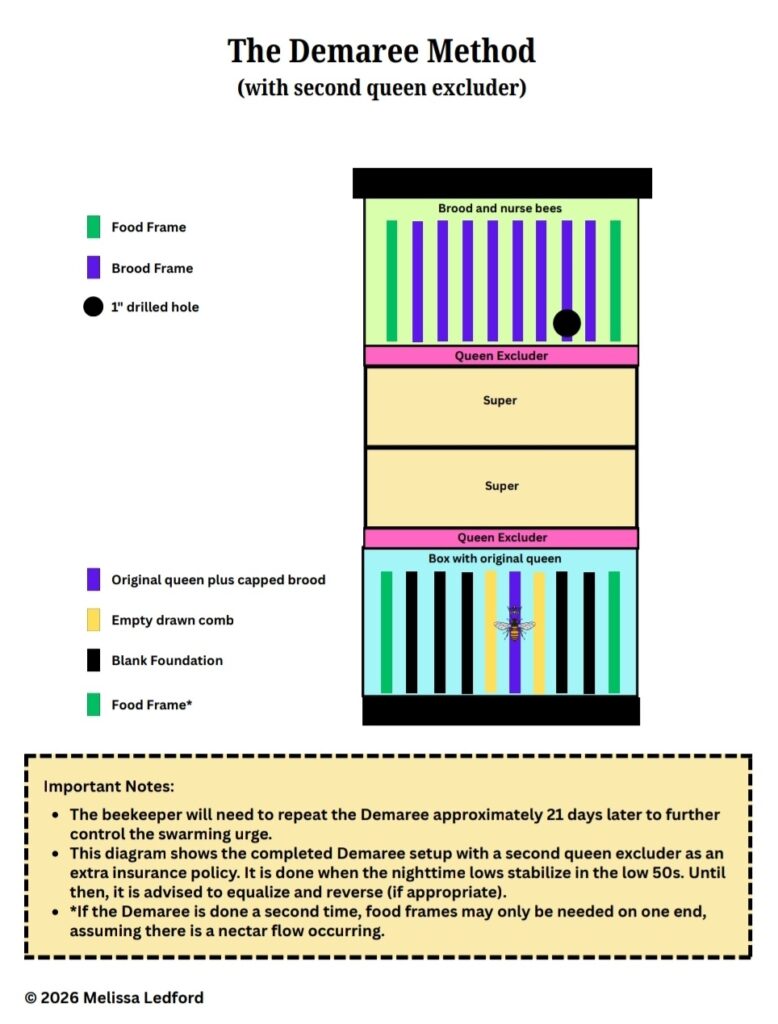
- Locate the queen carefully. I will place her in a roller cage and tuck her in my pocket to ensure her safety. You can also take a nuc box with you and place the frame with her on it inside the box and cover it to keep her safe. If this frame has a majority of capped brood on it, this will be a good frame to use in the lower box.
- Separate out the brood frames from empties and blanks.
- Place the frame of capped brood with the queen on it in the middle of the bottom box.
- Place a mix of empty foundation and empty drawn comb on each side of the brood frame.
- I will often put a frame of empty comb on each side of the brood frame and place empty foundation from there on.
- Leave a frame or two of food on the ends of the box.
- Place a metal queen excluder on top of the brood box. The metal excluders seem to have better flow-through than plastic ones.
- Place a couple of supers on top of the excluder. If you have a good locust flow going, be generous with the supers.
- Here’s where I am a bit different. I like to place a second metal excluder on top of the upper super. It is my little insurance policy and the reason is below:
- I have had virgin queens emerge because I accidentally missed the beginnings of a queen cell.
- According to Murphy’s Law, the virgin queen will venture out and mate extremely well.
- The newly-mated queen excitedly lays eggs in every single cell in the beautiful comb in the supers because to her it is perfect.
- She ignores the upper box.
- The super is now a brood box.
- Thus, we now have an upset beekeeper.
- The moral of the story is to use a second excluder.
- The second excluder is placed on the upper super.
- Place the second deep on the excluder. Please leave an upper entrance so the drones can fly out. The drones will not be able to squeeze through the queen excluder and will get stuck and die. I often drill a one-inch hole in the box.
- This second box should be mostly all brood in various stages (capped, open and eggs).
- It doesn’t hurt to leave a couple of frames of food as space allows.
- If the bees get locked in due to rainy weather, this food is good to have in place.
- Close them up and wait eight days.
- On day eight, you need to open the top box.
- Shake off each frame; there shouldn’t be a single bee left.
- Identify queen cells and cull them.
- According to Jake, queens raised in the top box of a Demaree are normally not quality queens. As hard as it is, it is best to cull them.
- Double check each frame again. Anything that might resemble the beginnings of a queen cell should be discarded.
- Close them up.
- You culled on day eight. Mark your calendar for another 13 days. This will be day 21 of the Demaree.
- It is important to note that many publications will say to pull the second box on day 25. This allows all worker and drone brood to emerge. I have found this to sometimes be too late. I prefer to check on day 21. A 21-day cycle tends to be more appropriate for our area, solely based on my experience.
- The second brood box will most likely be filled with food frames now since the brood has emerged. This is a great resource to have! I keep the frames in the freezer and feed back to the bees as needed. I also use the food frames in splits.
- Day 22: Start over.
- You will only have one brood box to work with this time.
- You may not need to include frames of food on both ends of the upper and lower boxes. Nectar should be coming in strong; pay attention to the bees’ behavior and what they are bringing in and building. If you see lots of white wax or “frosting” wax, that is indicative of good nectar flow.
- Repeat all of the steps above and mark your calendar accordingly to cull cells and repeat a third time if needed.
Final Thoughts
If done correctly, the Demaree should keep your bees in their homes until the swarming urge has passed. As mentioned previously, timing is everything. Please do not rely on dates. The weather in the Ohio Valley is just too unpredictable from year to year. Keep a journal of what blooms and at what times. Use binoculars and look in the trees. Take note of dandelion blooms. Listen to your bees and watch their behaviors. It will take a couple of seasons to figure out what works best for you. But it will all come together and could be a good tool to use for your apiary management.